上海滩
Apple deletes guide on Chinese mainland Mac users accessing Alibaba’s Qwen AI_我的网站

一 |
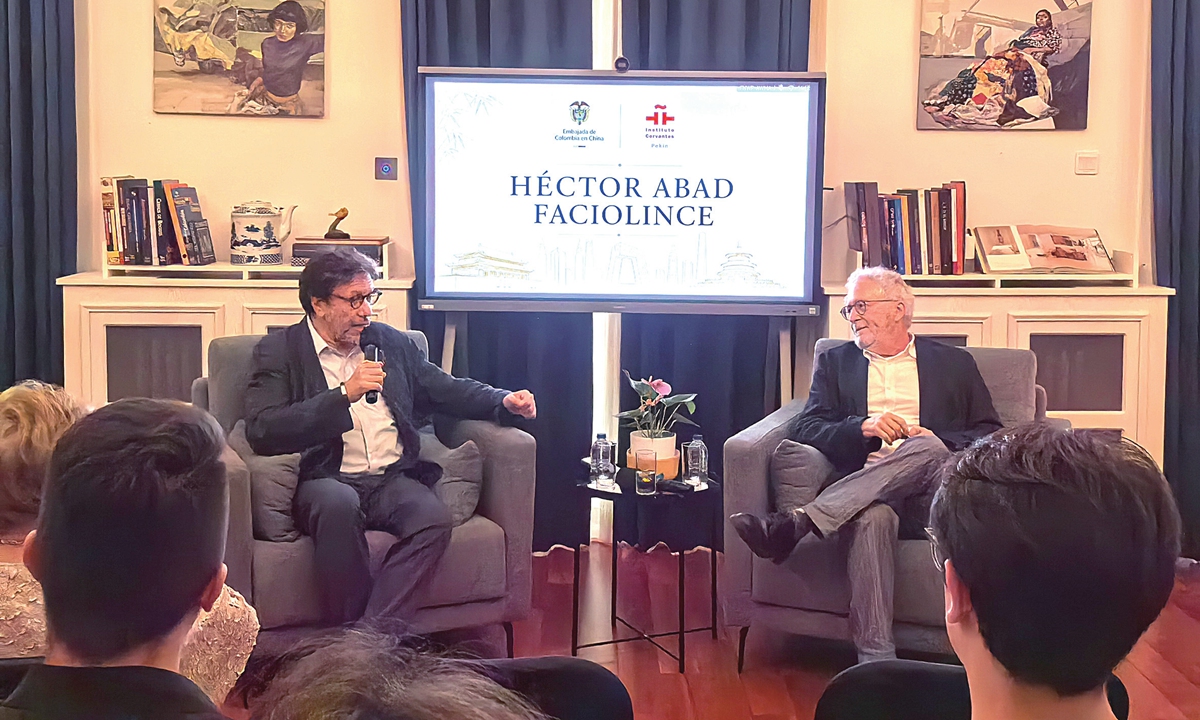
Santiago Gamboa, writer and minister counselor of the Embassy of Colombia in China, (left) and Héctor Abad Faciolince, a Colombian novelist, writer and journalist at a sharing session at the Embassy of the Republic of Colombia in China on August 18, 2026. Photo: Dong Feng/GT
The Embassy of the Republic of Colombia in China hosted a colloquium with Héctor Abad Faciolince, a Colombian novelist, writer and journalist. The writer shared on Tuesday his growth journey from a journalist to achieve his dream as a writer, his observation of the Colombian society and his impression about the changes in China.
In a fully packed hall, Minister Plenipotentiary Jose Fernando Bermúdez Cendales said in his opening remarks that the event is part of an initiative to bring Colombian culture closer to the Chinese public while simultaneously creating new spaces for dialogue and exchange between the two countries.
Bermúdez said that Abad's visit to China offers a particularly valuable opportunity to showcase the richness of our literature and to strengthen the cultural and human bridges connecting Colombia and China.
The session, chaired by Santiago Gamboa, writer and minister counselor of the Colombian Embassy, focused on the career and body of work of Abad and in particular,
El olvido que seremos (Oblivion: A Memoir).
Abad's book is a seminal work of contemporary Colombian literature in which personal and family memory engage deeply with Colombia's recent history. Its translation into Chinese allows this story to reach new readers and represents an extraordinary opportunity to bring both societies closer together through literature, per some commentators.
"We hope this gathering will be an open conversation among cultures, readers, and experiences, and a new expression of the friendship that Colombia and China continue to build," said Bermúdez.
Abad, one of the most important voices in contemporary Latin American literature, shared with the Global Times that this is his second trip in China. The last time he visited the country was two decades ago.
This time, in his eyes, China has changed a lot. In many ways, the country stands for the future of the world.
Abad said he is surprised to see how much Chinese people are depending on the electric devices and network to communicate in a virtual world, and said that he felt "like an alien."
Talking about his interaction with readers in Shanghai, Abad smiled, saying that the readers selected some phrases from his book and asked him to write down as part of the autography and signature for them.
In his book,
El Olvido Que Seremos (The Oblivion We Will Be), which is acclaimed as a "love letter from a son to his father," is not only a deeply affectionate look back at familial bonds but also a courageous attempt to defy oblivion.
Rooted in true events,
The Oblivion We Will Be chronicles the life of his own father. Abad noted that his father was killed in August 1987 - nearly forty years ago.
In the Western literary tradition, a father is often portrayed as a distant or even negative figure. His father, however, was "totally different - a man of love and deep sense of responsibility in both the public sphere and his family life."
Such image of a benevolent, non-authoritarian father has impressed his Chinese readers as well, he said.
As a physician, Abad's father dedicated his life to addressing fundamental issues affecting people's well-being, such as drinking water quality and public health, steadfast in the belief that the world could be made better through action.
Abad's work addresses themes such as memory, violence, inequality, and the human condition, deeply marked by the murder of his father, an event that inspired his most iconic book, The Oblivion We Will Be was published in Chinese by Writer's Publishing House in Beijing in July.
。

An Apple store in Shanghai Photo: VCG
Apple has removed a guide saying Mac users in Chinese mainland can connect Alibaba's Qwen artificial-intelligence service, the Global Times found on Sunday.
An Apple customer‑service representative confirmed the page’s removal to the Global Times but gave no reason behind the move.
Apple Intelligence has been formally integrated into Alibaba's Qwen model on macOS, according to Apple's Chinese website on Saturday.
A screenshot from Apple’s Mac user‑guide shows that once enabled, Siri can conduct in‑depth photo and document analysis with Qwen, while the native writing tool generates text and images from user prompts. As an example, users may tell Siri to ask Qwen to compose a poem. The Qwen extension runs on macOS 26.6 or later versions, available for users located in Chinese mainland or devices purchased in the region.
The shift comes amid the roll‑out of Apple’s much‑hyped artificial‑intelligence services in the Chinese mainland.
“The takedown of the support‑guide page might signal pending tweaks to technical details amid ongoing regulatory progress,” Liu Dingding, a veteran tech analyst, told the Global Times on Sunday.
On July 15, China's cyberspace regulator published its latest registration list for generative AI services, under which seven on-device generative AI services for mobile phones, including "Apple Intelligence," completed registration. The filing lists Apple Technology Development (Shanghai) Co as the registrant for "Apple Intelligence," according to the official WeChat account of Cyberspace Administration of China.
Alibaba's Qwen model would be integrated into Apple Intelligence across Apple's iPhone (iOS), iPad (iPadOS), Mac (macOS) and Vision Pro (visionOS) operating systems in China, Reuters reported in July.
。

二 |
Current article:http://4hivut.bainangmieruopanglaomen.sbs/h97/6r4qx.html
Published on:00:00:00


